
Hypnotherapy for panic attacks uses guided relaxation and focused suggestion to calm an over-reactive nervous system and reframe the fear that fuels panic. The change tends to build gradually across sessions. Many people find their attacks grow less frequent and less intense, especially when hypnotherapy sits alongside other support.
Your heart slams, your chest goes tight, and a wave of dread rolls in while you are standing in the supermarket queue or halfway through a work meeting, with no obvious reason behind any of it.
If you have started looking into hypnotherapy for panic attacks, you have likely tried the breathing apps, the grounding tricks, and plain willpower already.
You want something that reaches what is actually driving it. At HypnoGenie, Amanda works with people right across Australia, in person in Perth and online wherever you are based.
Here is how hypnotherapy works for panic, what a session involves, how many you might need, and how to tell whether it is right for you.
What Is Actually Going on When You Have a Panic Attack

A panic attack is a sudden surge of intense fear that sets off real physical symptoms even when nothing around you is dangerous.
Your heart pounds, your breath goes shallow, your head feels light, and a strange conviction takes over that something is badly wrong, maybe that you are about to collapse or lose control entirely.
What is happening underneath is your fight-or-flight system firing at full strength, flooding your body with adrenaline as though you are facing a genuine threat. The response is doing its job perfectly; it has just been triggered by the wrong cue.
That misfire is why panic attack triggers can feel so random. A crowded shop, a particular stretch of motorway, a physical sensation that echoes a past attack, sometimes nothing you can name at all.
Once your nervous system has learned to treat these moments as emergencies, it keeps sounding the alarm, and recurring panic attacks settle into a pattern that feels increasingly out of your hands.
You are far from alone in this. According to the ABS National Study of Mental Health and Wellbeing 2020 to 2022, around 17.2% of Australians aged 16 to 85, roughly 3.4 million people, lived with an anxiety disorder in a given year, with women affected more often than men (21.1% against 13.3%).
Panic disorder sits within that same anxiety group, which means the experience you are having is common, recognised, and well understood.
Understanding the mechanism is the first step; the harder part is the loop it creates.
Why Your Panic Keeps Coming Back
After a bad attack, part of your mind starts bracing for the next one, and that watchfulness has a name: anticipatory anxiety.
The fear of panicking becomes its own trigger, so you begin steering around the places and situations where an attack once caught you.
Each thing you avoid teaches your nervous system that the threat was real, which tightens the loop and hands panic more territory.
Reaching that automatic, below-conscious layer is exactly where an approach like hypnotherapy comes in.
Can Hypnotherapy Really Stop Panic Attacks?
Hypnotherapy can genuinely help reduce panic attacks by calming the nervous system and reshaping the automatic fear response that drives them.
It works best as part of a wider plan, and results vary from person to person, though many people find their attacks become less frequent and less intense over time.
The research backs this up, with a sensible caveat about what has actually been measured. A 2019 meta-analysis in the International Journal of Clinical and Experimental Hypnosis by Valentine, Milling and colleagues pooled the trial evidence on hypnosis for anxiety and found a strong effect: the average person who received hypnosis ended treatment doing better than roughly 79% of those who received no treatment, and that gap widened at follow-up.
Most of this work looks at anxiety broadly, since panic-specific trials remain limited, so the honest read is that hypnosis has solid support for the anxiety family that panic belongs to, with its strongest results showing up when it is paired with other approaches such as talking therapy or work with your GP.
That last point matters for how you set your expectations, which brings us to what hypnotherapy is actually doing in your mind.
How Hypnosis Reaches the Part of You That Panics
Panic runs on autopilot, fired off by a system that reacts long before your conscious thinking catches up.
Hypnosis works by settling you into a calm, focused, deeply relaxed state where that reactive layer becomes far more open to new instruction.
In that state, a hypnotherapist can help your mind rehearse a different response to your triggers, so the cue that once launched an attack starts to register as safe.
You are guiding the change with help, rather than forcing it through willpower in the middle of a crisis.
Where Hypnotherapy Fits Alongside Other Support
Think of hypnotherapy as one strong strand in your recovery, woven together with whatever else is helping you.
For some people that means continuing with a psychologist or counsellor; for others it means keeping their GP in the loop, particularly if medication is part of the picture.
Amanda will talk through what you already have in place during your first conversation, so the work complements your existing care and nothing pulls in a different direction.
So How Does Hypnosis Actually Calm Panic?
The shift comes down to timing and access. When your body is relaxed and your attention is narrowed onto the therapist’s voice, the guard your conscious mind usually keeps up drops away, and the deeper patterns running your panic become reachable.
From there, hypnosis for panic attacks works by pairing your old triggers with a calm, settled response often enough that your nervous system starts to reach for the new one on its own.
Here is what that looks like in practice:
- Deep relaxation lowers the alarm: Your breathing slows and your body stands down, which is the opposite of the state panic needs to take hold.
- Focused suggestion offers a new script: While you are calm, the therapist guides your mind through a steadier reaction to the exact situations that usually set you off.
- Mental rehearsal makes it stick: Picturing yourself moving through a trigger calmly, again and again, trains that response until it starts to feel automatic.
- The safe association replaces the danger one: Over time the cue that once meant threat begins registering as ordinary, so the surge has nothing to fire on.
What a Hypnotherapy Session for Panic Attacks Is Really Like
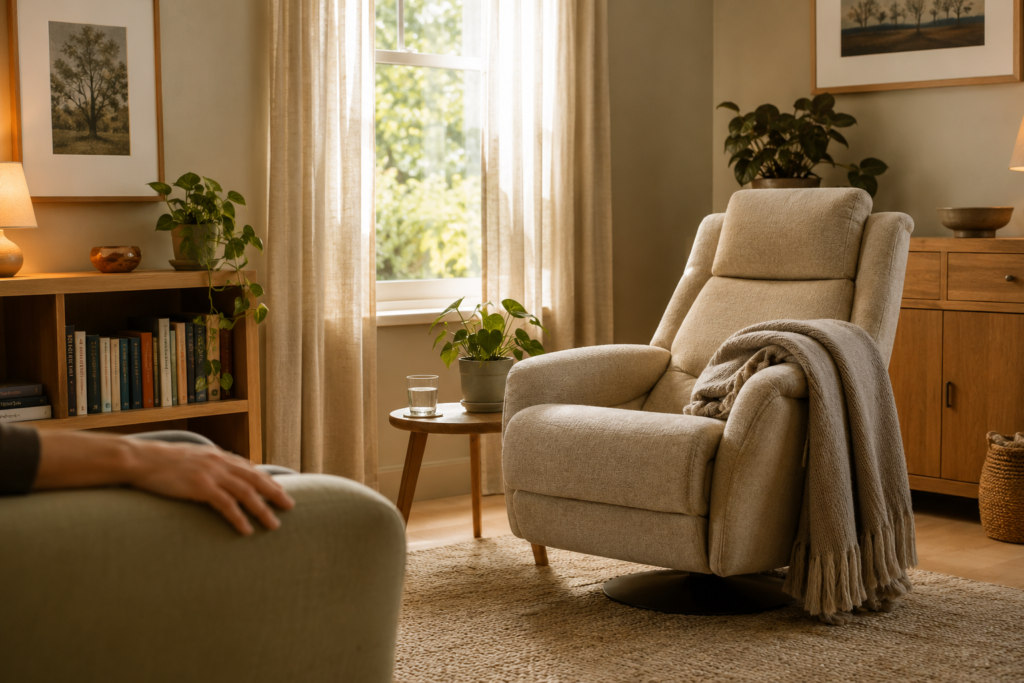
Most people picture something dramatic and come away surprised by how ordinary and calm it feels.
Your first session with Amanda opens with a proper conversation, no clipboard of standard questions, just her getting to know your panic: when it started, where it grabs you, what you have already tried, and what you want your daily life to look like without it.
From there she builds the session around you, because a trigger tied to driving needs different work than one rooted in social situations or health worries.
Once you are settled into a comfortable chair, here is how the rest tends to unfold:
- Gentle guided relaxation: Amanda talks you down into a calm, focused state at your own pace, with nothing forced and no need to “try” to relax.
- Focused suggestion work: While you are settled, she guides your mind through steadier responses to the specific situations you named earlier, in your words and around your triggers.
- You stay aware the whole way through: You can hear her, think your own thoughts, shift in your seat, and stop whenever you want; you are a participant, never a passenger.
- A short debrief at the end: She brings you back gently, checks in on how it felt, and often gives you a simple technique to practise before the next visit.
Because every session is shaped around the person in the chair, no two look quite the same, which is usually the point where people can feel whether HypnoGenie is the right fit for them.
Will You Lose Control or Get “Stuck” Under?
No, you cannot be made to do anything against your will, and you cannot get stuck in hypnosis. You stay aware the entire time and can open your eyes whenever you choose.
Hypnosis is a focused, relaxed state you move in and out of naturally, closer to being absorbed in a film than being switched off.
People respond at different depths, and that is worth knowing going in. Research suggests some of us drop into a hypnotic state readily while others settle more lightly, and both can benefit.
A skilled practitioner reads how you respond and adapts the approach to suit you, rather than pushing everyone through the same fixed routine.
How Many Hypnotherapy Sessions Will You Need for Panic Attacks?
There is no fixed number. Many people notice a shift within the first few sessions, and lasting change often takes somewhere between four and eight.
The exact count depends on how long you have lived with panic, how many situations trigger it, and what you want your results to look like day to day.
What shapes your number
A handful of things move the figure up or down. Panic you have carried for a decade usually asks for more sessions than panic that surfaced a few months ago.
Someone with a single, well-defined trigger tends to progress faster than someone whose attacks fire across many settings.
Your goals matter too: quieting the worst of the attacks is different work from wanting to walk into any situation without a flicker of dread.
How readily you settle into hypnosis plays a part as well, which is why Amanda gauges your response early and paces the work to match.
How Amanda tracks your progress
You will not be guessing whether it is working. At the start Amanda maps out where your panic sits and what you want to change, then checks in against that at each visit, asking how the gaps between attacks are stretching, how intense they still feel, and which situations have loosened their grip.
If something is shifting quickly, you may need fewer sessions than expected; if a trigger proves stubborn, she will talk it through and adjust rather than run a set number on autopilot.
You stay in the loop on the plan the whole way, so booking further sessions is always your call, made with a clear picture of what has already changed.
Calming Techniques You Can Use Between Sessions

The work you do with Amanda goes further when you have a few tools of your own for the moments panic shows up.
These calming techniques for panic attacks are simple enough to reach for in a supermarket queue or at your desk, and each one gives your nervous system a signal that the emergency is over.
- Slow your out-breath: Breathe in for a count of four, then out for a count of six or seven, letting the exhale run longer than the inhale. The long out-breath is what tells your body to stand down, so a few rounds can take the edge off a rising attack.
- Ground through your five senses: Name five things you can see, four you can hear, three you can touch, two you can smell, and one you can taste. Pulling your attention onto the room around you interrupts the spiral and pins you back into the present.
- Set a self-hypnosis anchor: Ask Amanda to teach you a quick self-hypnosis cue, a word or a gentle press of finger and thumb that you link to a calm state during your sessions. Once it is set, using that anchor in the moment calls back the settled feeling you have already practised.
- Move the adrenaline out: A brisk walk, shaking out your hands, or rolling your shoulders gives the stress chemicals somewhere to go, which is one of the most natural ways to manage panic attacks once the first wave passes.
Keep the ones that click for you and let the rest go; the point is having two or three responses ready before you need them, so panic meets a prepared you instead of a cornered one.
Getting Started With Hypnotherapy in Perth or Online Across Australia
Wherever you are, you can work with Amanda. HypnoGenie runs sessions in person for anyone after Perth hypnotherapy for anxiety, and through online hypnotherapy Australia-wide for everyone else, so a regional postcode or a packed schedule keeps no one out.
The online sessions carry the same structure and care as sitting in the room, from your own lounge.
A kind word on getting the right support around you. If your panic attacks are severe, frequent, or making everyday things hard to face, book in with your GP as well, since they can rule out other causes and talk you through the full range of options.
Hypnotherapy works comfortably alongside that care, adding to your recovery while your doctor stays across the medical side.
The easiest way to find out whether it fits is a low-pressure chat before you commit to anything. You bring your questions, Amanda listens to what you are dealing with, and you leave with a clearer sense of your next step, whether or not that step is with HypnoGenie.
Ready to loosen panic’s grip?
Hypnotherapy for panic attacks works by calming your nervous system and rewiring the fear response, so attacks lose their hold over time.
It is a gentle, drug-free option you can access in Perth or online, and you do not have to keep arranging your life around the next wave.
Book a free 20-minute discovery call with Amanda to ask your questions and find out whether hypnotherapy suits you.